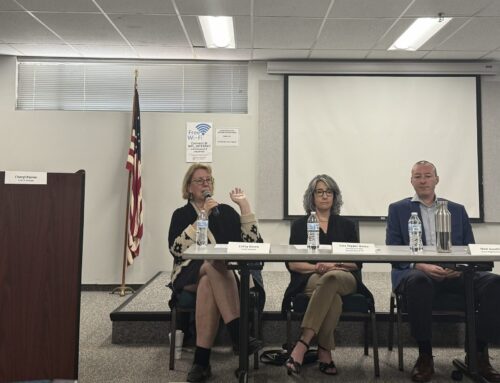

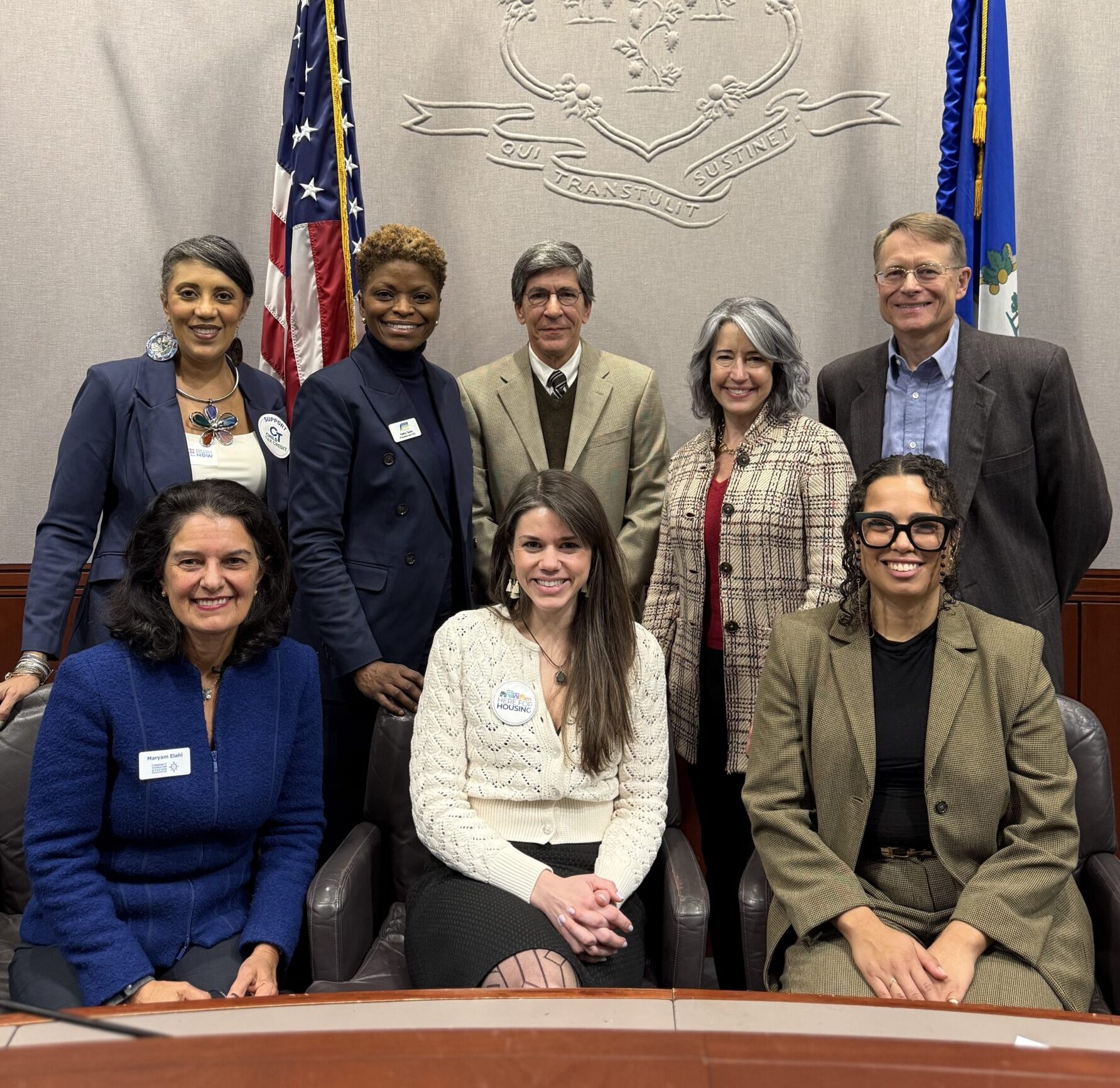
Pictured above: TOP ROW L-R: Karen DuBois-Walton (President & CEO, Community Foundation of Greater New Haven); Kathy Taylor (President & CEO, CT Community Foundation); Guy Rovezzi (President & CEO, Northwest CT Community Foundation); Lisa Tepper-Bates (President & CEO, United Way of CT); Merrill Gay (Executive Director, CT Early Childhood Alliance); BOTTOM ROW L-R: Maryam Elahi (President & CEO, Community Foundation of Eastern CT); Chelsea Ross (Executive Director, Partnership for Strong Communities); Carmen Clarkin (Special Assistant for Strategic Initiatives, CT Voices for Children)
By Alison Cross | Day Staff Writer
Published: Mar 19, 2026 6:00 PM
Hartford — Community advocates from the End Child Poverty Now coalition gathered at the State Capitol on Thursday to lobby lawmakers to pass policies that would support struggling families.
An estimated 206,880 Connecticut children — more than 28% of youths in the state — were living in or near poverty in 2022, according to a 2024 report from Connecticut Voices for Children.
Maryam Elahi, the president and CEO of the Community Foundation of Eastern Connecticut, said the campaign started three years ago with the idea that “in this rich state of Connecticut, we can and should end child poverty.”
Elahi said 120 organizations have signed on to the coalition’s 2026 policy goals to advance a child tax credit, housing stability, universal school meals and state-funded nutrition assistance.
“We are speaking on behalf of many people who don’t have the voice to be here,” Elahi said. “They’re working three jobs. They don’t have the ability to come and knock on the door of their representative, but surely their representatives need to be mindful of what they’re struggling and going through, especially in these times, and to ensure that they have the protection they need so that all of our children can thrive.”
Child Tax Credit
The coalition’s top priority is establishing a statewide child tax credit. The group is backing a plan to provide taxpayers with a $600 refund per child, with a maximum benefit of $1,800 per household.
Lisa Tepper-Bates, the president and CEO of the United Way of Connecticut, said the tax credit would offer much-needed relief to 127,000 families in the state who struggle to afford basic necessities like food, housing, utilities and healthcare.
“We know that 300,000 children in our state are in this … category,” Tepper-Bates said, adding that 97% of those children have at least one working parent.
According to the National Conference of State Legislatures, 17 states and the District of Columbia offer child tax credits that range from $75 to $3,200 per child.
“It is high time for the state of Connecticut to also have that state-level mechanism to support our families,” Tepper-Bates said.
Just cause evictions
Coalition members are working to end child poverty by increasing housing stability. This legislative session, advocates are pushing lawmakers to eliminate no-cause evictions and expand access to state rental assistance for low-income families.
Under current law, once a lease expires, landlords can refuse to renew the rental agreement and evict tenants without cause. The only renters who are protected from these “no-fault” evictions are seniors over the age of 62 and renters who have a physical or mental disability.
According to Growing Together Connecticut, a statewide consortium of affordable housing advocates, no-fault evictions currently account for 11% of all eviction filings in the state.
Chelsea Ross, the executive director of the Partnership for Strong Communities, said that for Connecticut’s children, an eviction leads to much more than a move.
“Families who are following the rules should not have to live with the constant fear that they could be forced out of their homes without a cause,” Ross said.
“Evictions for kiddos means their whole lives are upended,” Ross said. “They have to change schools. Parents lose their jobs because they have no stable place to live, and families are entering shelters or doubling up. Once an eviction is filed, it will follow a family for years, making it harder and harder for them to find housing again.”
Senate Bill 257 aims to extend just-cause eviction protections to any tenant who has rented from their landlord for at least a year.
The proposal would still allow landlords to file evictions against tenants who do not pay their rent, break their lease agreements, or pose a risk to the health and safety of the building. Landlords can also refuse to renew a lease if they intend to rent the unit to their child, grandchild, parent or grandparent once the tenant moves out.
The bill advanced out of the Housing Committee last week and now awaits a vote in the Senate.
The proposal has faced opposition from Republicans and some Democrats who have argued that if tenants have the right to not renew their lease, landlords should maintain the right to do the same on the property they own. Opponents of the measure said landlords rely on no-fault evictions to force out tenants who cause problems that do not necessarily constitute a lease violation. They said the bill could worsen the state’s housing shortage by raising tenant-screening standards to reduce risk.
Rental assistance
In addition to the just-cause expansion, Ross said the coalition is urging lawmakers to add $50 million to the state’s Rental Assistance Program, which provides housing subsidies to low-income families.
Ross said 6,700 families currently benefit from the program. Increasing the budget by $50 million would allow the state to serve 3,400 new households, she said.
“That’s a drop in the bucket. But if you’re one of those 3,400 families, that’s your whole world,” Ross said.
“You can’t end child poverty for children unless families have housing stability,” Ross said. “It’s the foundation that everything rests on for a family. When a child has a stable home, they’re more likely to succeed in school, to be healthy and to grow up with the stability that they deserve.”
Universal school meals
The coalition is also advocating for the return of free school meals for all students.
“During the pandemic, we provided free breakfast and lunch for all children. It made a huge difference,” said Merrill Gay, the executive director of the Connecticut Early Childhood Alliance.
“Allowing every child to get a free breakfast and lunch is a way that we can make sure that children are ready to learn and able to learn at school.”
Federal subsidies that provide free and reduced-price meals to students are based on the federal poverty guidelines. In Connecticut, a family of four stops qualifying for free meals once their annual household income surpasses $41,795. Reduced-price eligibility stops at $59,478.
Currently, 44% of public school students in the state qualify for free meal subsidies, but Gay said many more students are going hungry in their classrooms.
“We’ve got lots of families who earn too much to qualify for free or reduced meals at school who are now racking up debt at school cafeterias or missing meals,” Gay said.
According to testimony from the Connecticut State Department of Education, universal school meals would cost the state $64.3 million a year.
Food assistance
The coalition is also calling for a state-funded food assistance program that would restore benefits to households that lost eligibility for the federal Supplemental Nutrition Assistance Program — known as food stamps — under President Donald Trump’s administration.
“New rigorous work requirements and other barriers to SNAP went into effect on Dec. 1, 2025. And since November of last year, we’ve seen nearly 17,000 people in Connecticut roll off the federal benefit,” said Carmen Clarkin, Connecticut Voices for Children’s special assistant for strategic initiatives.
“We cannot food bank our way out of this problem. Emergency food from food pantries is a support, but it’s not intended for long-term use,” Clarkin added. “Creating a state-funded program as soon as possible to help support those losing access is critical to the social safety net and to make sure that these programs are maintained.”
Senate Bill 497 would dedicate $40 million to this proposed initiative.
“Hunger in Connecticut is not an inevitability,” Clarkin said. “It’s a policy choice that we have the power to change.”
a.cross@theday.com